On my way to the last Giants game of the season, I struck up a conversation with the guy sitting next to me. I probably shouldn’t peek at his phone, but I couldn’t help noticing he was reading an article titled “747s and Coding Agents” — at the same time, I was reading a romance novel. Speaking of the competition in the Bay Area, haha.
I’ve been wanting to write this down since last Sunday, when I had this conversation with the guy sitting next to me on the CalTrain. Finally, I caught some time today. I really should have asked for that guy’s name, email or phone number — I’ve been regretting it for about a week. Let’s call him “Michael.”
We talked a bit about our careers, and I mentioned I’m creating agents and building things with OpenClaw, and how I’ve been utilizing OpenClaw and agentic tools to an extent that a good amount of things are handed over to my personal agent, Gideon, to help finish. Michael brought up more details from Carl Kolon’s article “747s and Coding Agents”.
One thing Michael brought up is the point from the article:
In this job, after a while, there’s no improvement. You are no better today than you were yesterday.
Which, to Michael’s point, is basically what AI is doing: AI is only doing what a human is doing, but faster. AI cannot figure out how to make a process better — a human still needs to tell it. AI cannot initiate and figure things out.
To this piece, I would have agreed if it were Feb 2026. I would have totally agreed. Now, in October, I don’t think I would agree at all.
That article was written in Feb 2026. Now, in September/October 2026, things are vastly different. Self-improving AI is a thing now — if you build a good harness around it. Gideon is that case: I talked about the to-do board I worked on with Gideon, and every week Gideon goes through my todo items and suggests what Gideon can take on. That was actually Gideon’s idea.
I do have rules, though. Before AI is going to work on things, it ALWAYS needs to write down a plan and have me review it. Throughout that plan, I’m checking the logic and the frameworks it’s using — if an API is involved, how AI is planning on writing the API. Basically the overall architecture and design, and of course the overall logic.
I also force my AI to write a README all the time. The README should document the following:
- How to set up the environment
- What we are doing
- Why we are doing this
- Business case, reasoning overall behind it
- Special use cases / Edge cases
- What language it will be written in & why we picked this language
- Logic of overall program
- End Summary
- Lessons learned while we build this out
Bottom line: I should be able to hand this README to a person who never talked to me about what we’re doing here, and after they read it, they should understand, and be able to give me 8–10 sentences of what we’re doing. I’ve been using this technique to “proofread” my coding plan.
That’s also how I keep up, and it’s the part I don’t think gets said enough: reviewing code line by line stops working the moment the codebase outgrows one person’s reading speed. The plan review and the README are what keep me in the loop when I can no longer read every line. That’s the trade I’ve made — the more the agent builds, the less I read the code, and the more I lean on the artifacts around it.
Another piece I would like to touch on is also based on Carl Kolon’s article — his example of how AI has changed how he approaches problem solving:
It has changed how I solve problems, and at times I feel more like a pilot than an engineer.
I absolutely agree. Back in March, when I first started using AI, I was still doing a good amount of research before I started doing things. As the LLM gets better and better, and as I feed it more and more context, AI knows me better as well, and it can finish the task exactly how I was picturing it. On top of the task, it can also identify areas I may not think of, and work on them.
This doesn’t change the fact that the learning piece is getting harder and harder. Now I’m treating AI more as my programmer than anything else. I still review things — however, it’s also harder now. I mean, AI was able to write me a full accounting app, which with the complexity of everything, probably would have taken me more than a week to finish. It had 15 different coding files with routing, frontend, backend and a database — and I just added a reconcile feature to it, so the line count is probably higher now. For a human to review all of that code is also hard. AI knows more than any human being at this early stage. Learning needs to be faster and faster along with it.
I don’t know if anyone else is feeling the same way as me. I feel like with the advancement of AI, I sometimes get information fatigue — there are constantly new models coming out, new concepts coming out, but I don’t have enough time to catch up on everything.
AI is here to stay, and no one can really tell where everything is going in the future. What we can do is focus on what’s happening now. AI can help improve your current process, and regarding learning, work with AI to learn faster than before. For me, it really depends on what I’m doing: there are things I want to know exactly how they work, and I will have AI come up with a curriculum for me — pretend I’m a 5 year old, spread over about N weeks, and teach me the subject.
I’d like to end this piece by borrowing Einstein’s words:
“All physical theories, their mathematical expressions apart, ought to lend themselves to so simple a description ’that even a child could understand them.'”
— said during a conversation with de Broglie in Paris, as documented in Ronald W. Clark’s biography Einstein: The Life and Times (1972). ( source)
That’s basically the concept I’m borrowing: if I can’t explain what we’re building to someone who’s never seen it, I don’t understand it yet either. Which is why the README matters more now, not less.
Happy coding, happy managing AI.
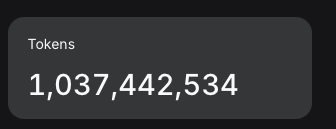
P.S. I just hit over 1,000,000,000 tokens with my AI tools — accumulated over the past few months. It’s a milestone in my journey with AI!
This post was written with Gideon — my AI agent, and the one in this story. He helped stitch it together, which is either the whole point or a slight conflict of interest. Still all of my words, Gideon fixed grammar and spelling.